The Best Thing About The Satanic Panic
It’s the name. It’s so good.
Recently my brain has been fixated on this question: What would we call the Satanic Panic if those words didn’t rhyme?
For readers too young to remember, the Satanic Panic was a widespread moral panic in the late ’80s and early ’90s where some people believed that Satanic cults were abusing children and influencing pop culture through things like heavy metal and Dungeons & Dragons.
It was a moral panic over Satanism. A Satanic Panic. It’s maybe the most perfect name for anything ever. It works so simply. It describes what it is. It’s slightly sing-songy. And of course, it rhymes.
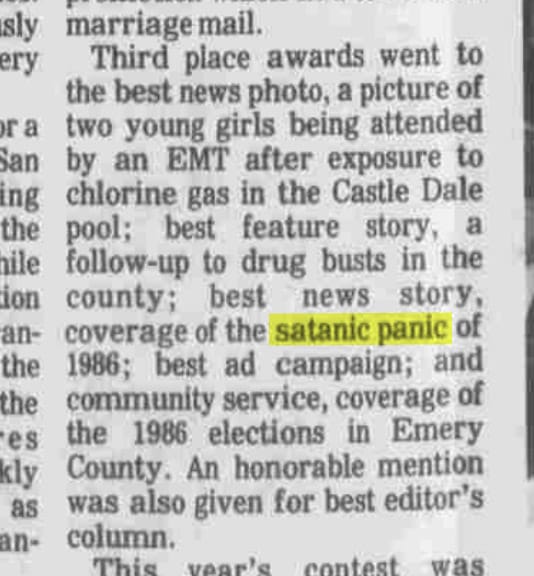
The Oxford English Dictionary cites an article in Utah’s Emery County Progress as the first published use of “satanic panic,” on February 24, 1987. But funny enough, the article itself wasn’t even about the satanic panic but about an award the newspaper received for its coverage of the panic. The original award-winning article did not use the phrase.
By 1993, the phrase had caught on enough that it became the title of a book called Satanic Panic: The Creation of a Contemporary Legend.
So what did people call it before Satanic Panic? While the panic was spreading, the term floating around was Satanic Ritual Abuse, or SRA for short. A book about the panic came out in 1991 called The Satanism Scare which isn’t a terrible name, and had alliteration going for it, but wasn’t the term that ultimately caught on.
So why did Satanic Panic finally catch on?
Because People Like Rhymes
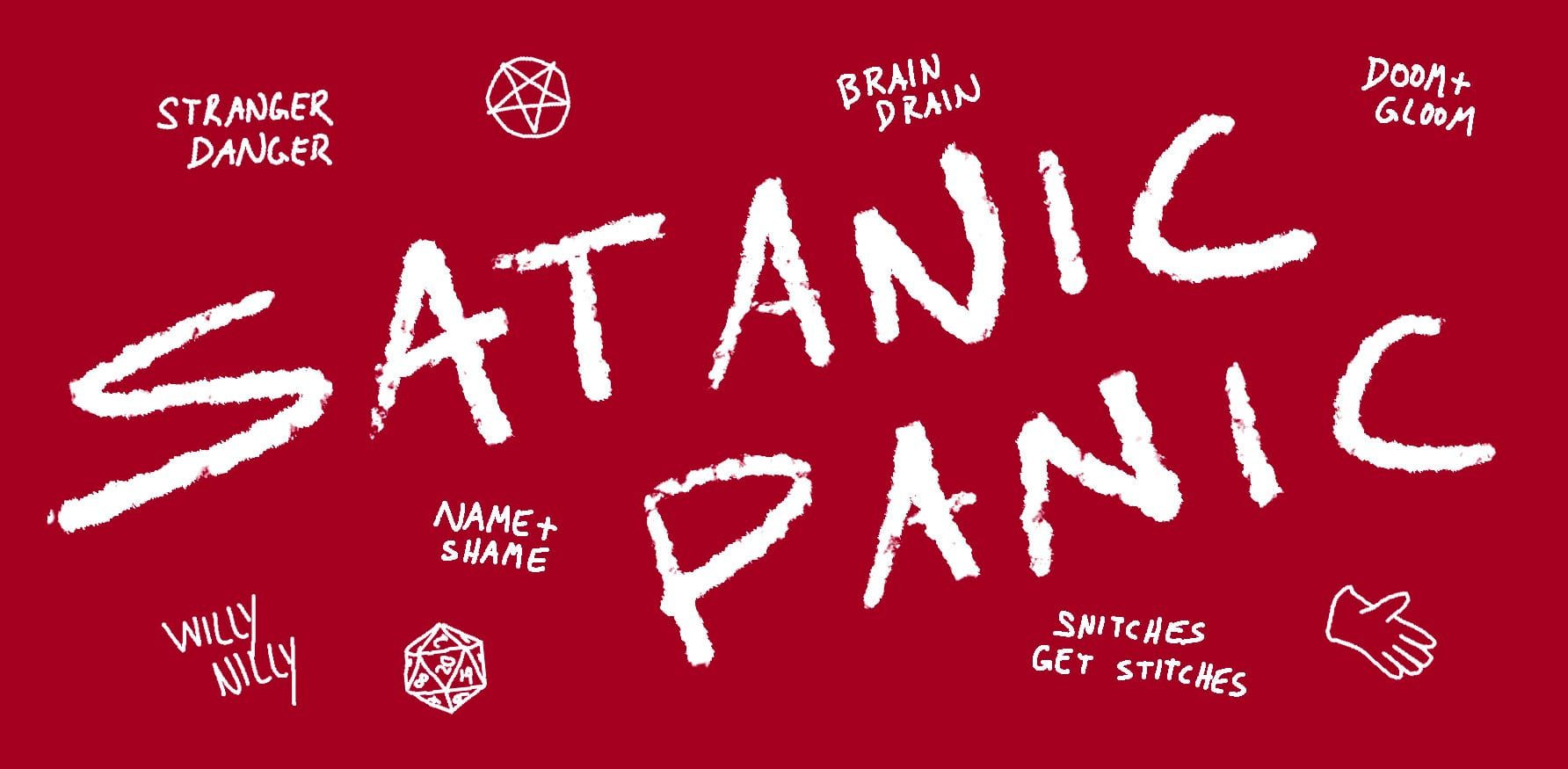
Satanic Panic isn’t the only phrase that’s perfect in how simply it describes something while rhyming. Look at Stranger Danger, Brain Drain, Name and Shame, Doom and Gloom.
They’re such perfect phrases.
And then there are rhyming aphorisms. Snitches get stitches. A friend in need is a friend indeed. An apple a day keeps the doctor away. No pain, no gain. Drop that zero and get with the hero.
There’s a phenomenon called the rhyme-as-reason effect that says people are more likely to believe something is true if it rhymes. A 2000 study published in the journal Psychological Science with the excellent title Birds of a Feather Flock Conjointly examined this phenomenon. 100 volunteers were given aphorisms that either rhymed (“Life is mostly strife”) or were modified to not rhyme (“Life is mostly struggle”) and asked to rate them for accuracy. The group that was given the rhyming versions rated them as more accurate.
That’s why “If it doesn’t fit, you must acquit” worked for Johnnie Cochran a lot better than “If it doesn’t fit, you must find my client not guilty” probably would have.
A 2021 study on rhyme and memory, with the less-excellent name Rhyme as resonance in poetry comprehension, found that rhymes work with the brain’s “resonance model,” the idea that every time you read a word, your brain scans its index of other words for any similarities and recalls those words. Rhyming words are easily surfaced as related.
They didn’t explore how this happens as much as they confirmed that it does happen. And the connection happens even faster for people who are professional rhymers, like poets or rappers.
So rhymes help people remember things, and rhyming phrases are deemed more accurate than non-rhyming phrases. So maybe the phrase “Satanic Panic” was memorable because it rhymes, and the rhyme also reinforces the idea that the whole phenomenon was a moral panic.
Would we still talk about it as much today if it didn’t have a rhyming name? Would there be so many podcasts about the Satanic Panic if we referred to it as “SRA”?
More Rhyme Stuff
Then there are the sort of nonsense rhymes like helter-skelter or razzle-dazzle or chit-chat. These are called reduplicatives, and in these cases the rhyme is integrated with the compound word. One half might work on its own, but somehow together they make their phrases feel more finished.
I mean, sure. A good ghost story can give me the heebies. But it’s somehow more satisfying for it to give me the heebie-jeebies. And yeah, I’d understand if you were to describe something as teensy. But call it teensy-weensy and you’ll really make your point.
A 2022 German study on reduplicatives found that using reduplicative phrases results in “an increase in perceived euphony, funniness, familiarity, appreciation, and positive belittling (cuteness).”
[I need to pause for a moment to appreciate cuteness being called “positive belittling.” Now back to our story.]
But beware before you start throwing reduplicatives around willy-nilly: in addition to all those nice effects, reduplicatives also caused a decrease in arousal. So keep that in mind if you’re ever tempted to call your partner your little honey-bunny.
A Tangent From 2007
There’s another kind of reduplicative where the words don’t just rhyme, they’re actually identical. Think of phrases like “goody-goody” or “cha-cha.”
Back in 2007, I wrote a poem using as many of those as I could think of. I present it to you now for your enjoyment.
Murmur.
Zsa zsa slapped a cop
who pulled her over in La-La land.
She left a booboo on his face
From all the bling-bling on her hand.
Dance the cha cha
Or the can can
Shake your pom pom
To Duran Duran
Bora Bora is an island
Walla Walla’s in the US.
The UN’s Boutros Boutros-Ghali
used to live near the Suez.
When you say night-night to your baby
there’s a fifty-fifty chance
That she may have gone wee-wee
Or made a doo-doo in her pants.
Mahi Mahi is a fish.
Add some tartar, it wouldn’t hurt.
Couscous makes a great side dish.
Have a bonbon for dessert.
Lulu wore a muumuu
cocoa-colored like her friend’s.
Fifi said it’s too matchy-matchy
But they’re buddy-buddy ’til the end.
The Mamas and the Papas
Made “Monday Monday” a #1 hit.
Hindsight being 20/20,
Maybe the band shouldn’t have quit.
Mork said “Nanu Nanu.”
Luke rode on a taun-taun’s back.
Ralphie wants a BB gun,
and Mimi’s makeup’s out of whack.
“Knock knock” began the joke.
Lulu asked, “Who’s there?”
But the rim-shot came too early
on the tom tom and the snare.
Sirhan Sirhan shot RFK
It was a dum-dum move, that dork.
They would have sent him to Sing-sing
If he had done it near New York, New York.
“Ha ha” said Jerry Seinfeld
watching the “Yadda yadda” show.
Tsk tsk! Laughing at your own show’s jokes
is a TV writer no-no.
The dada artist drew a yo-yo
Being played with by a tsetse fly
Who was standing on a putt-putt course.
Nobody understood why.
The dodo birds have gone extinct.
Tut tut, there are no more living.
“Gobble gobble” says the turkey.
“Have a vegetarian din-din this Thanksgiving.”
Peter Pan was a goody goody
who lived in Never Never Land.
But now he’s on the wah-wah pedal
playing in a hard rock band.
It’s the same old same old with these rhymes.
And so it’s almost time to say bye-bye.
I’m running out of things to write. Um…
A sailor says “Aye aye.”
Choo choo goes the train.
Vroom-vroom goes the Corvette.
Oh no, this is my worst rhyme of all.
Now they’ll never link to me from boingboing.net.

I should perhaps explain that being linked to from BoingBoing was a big deal in 2007. The rest of the poem is timeless.
Or maybe I should explain the line about Zsa Zsa, too. See, back in 1989, the actress Zsa Zsa Gabor slapped a traffic cop. And for some reason, this was huge news. I mean, huge. They called it “the slap heard round the world.” It was probably the most important slap in the entertainment world until Will Smith went to the Oscars that one time.
Anyway. That brings another edition of the newsletter to a close. Thanks as always for reading. See you next time!
David